Home Renovation · Solar
Plug-in Solar
Plug-in solar, often called balcony solar, means small photovoltaic panels that connect through a standard outlet and offset electricity being used inside the home. It is closer to a solar appliance than a full rooftop construction project.
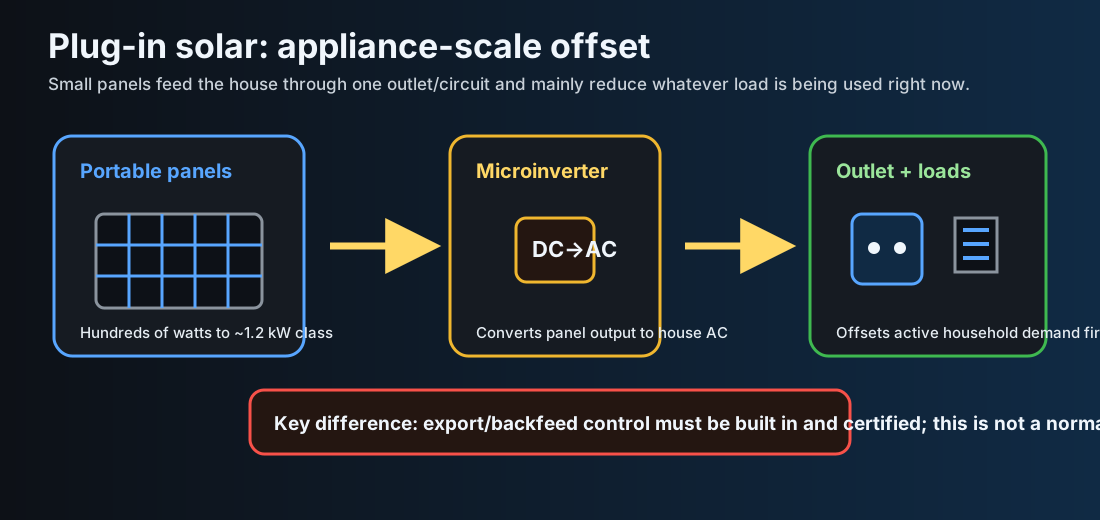
Plug-in solar is small and local: panels → microinverter → outlet/circuit → current household loads, with certified export/backfeed protection as the key safety issue.
Status check required: California legislation is moving, but do not assume every plug-in product is legal, utility-approved, permit-free, or safe for a Ventura installation. Verify the current law, utility requirements, UL certification, and local rules before buying.
How it works
- Panels produce DC power.
- A microinverter converts it to AC.
- The system plugs into a standard outlet or dedicated circuit and offsets nearby/home loads.
- Some designs try to prevent export/backfeed by throttling output or using monitoring/control hardware.
California SB 868 reference point
California SB 868 defines a “portable solar generation device” as moveable PV with maximum aggregated AC output of 1,200 watts per dwelling, designed to connect through a single standard outlet, intended to offset onsite consumption, compliant with NEC/California Electrical Code, certified by UL or equivalent, and including certified anti-islanding/backfeed protection. The bill text also proposes exemption from utility interconnection requirements, with possible simple online registration.
Why it might be attractive
Low commitment
Potentially much cheaper and more reversible than a rooftop system.
Good for pilots
Useful for learning household load patterns before a full installation.
Portable
Can make sense for renters or households not ready for roof work.
Limitations for the Ventura house
- Small size: a 1.2 kW-class cap is tiny compared with what a large south-facing roof could host.
- Unclear local pathway: Ventura has established processes for rooftop PV, but plug-in solar may depend on still-evolving state/utility treatment.
- Safety matters: the product must be certified, anti-islanding must work, and the circuit must be appropriate.
- Limited savings ceiling: if the home has high electric load, plug-in solar may shave bills but not transform them.
Ventura take: plug-in solar is worth monitoring, but for a home with a large south-facing roof it is probably a side experiment unless the roof is near replacement, the budget is constrained, or the goal is a small portable system rather than maximum production.
Sources